There’s a question that comes up again and again among parents and caregivers: “Why isn’t my child making progress?” Sessions are happening, exercises are being done at home — but the speech isn’t getting clearer, the drooling hasn’t stopped, feeding is still a struggle.
In many of those cases, the missing piece is oral motor work. The one that is more structured and tool based therapy.
TalkTools Oral Placement Therapy (OPT) works on the fact that speech is something your muscles have to physically learn to do. People who have weaker oral muscles need more than just seeing a therapist. They need to understand and feel the position of the tongue, how the lips should close and the function of the jaw. That’s what talk tools oral motor exercises provide — through a structured set of tools and a hierarchical therapy programme designed and overseen by a trained Speech-Language Pathologist.
What Are TalkTools Oral Motor Tools?
The Talk Tools Kit for Oral Therapy includes tools like the Horn Kit, Straw Kit, Bubble Kit, Jaw Grading Bite Blocks, and the Sensi vibration tool. Each one targets specific oral motor skills — lip closure, tongue retraction, jaw stability, breath control. ARK oral motor tools, particularly the Z-Vibe, are also commonly used alongside TalkTools in clinical settings. Many therapists draw from both ranges within the same programme.
TalkTools Oral Placement Therapy adds tactile and proprioceptive input — direct physical stimulation to the mouth — on top of the auditory and visual cues that conventional speech therapy relies on. It’s this third layer that makes the difference for clients who haven’t responded to traditional approaches.
Who Benefits from TalkTools Oral Placement Therapy?
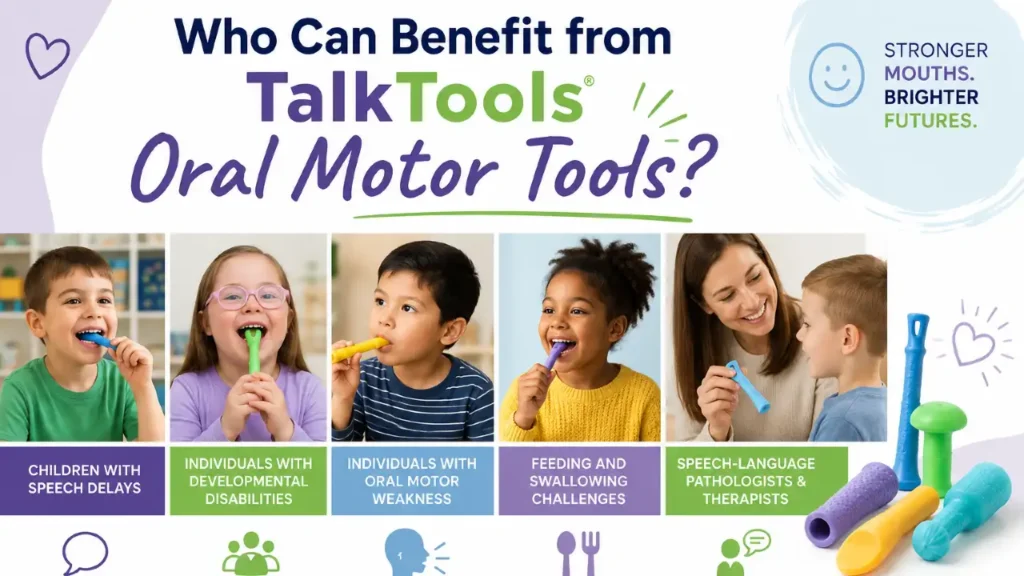
The range is wider than most people expect. Here’s who benefits most.
Babies and Toddlers with Feeding Difficulties
Oral motor challenges often show up first during feeding — trouble latching, tiring quickly at the breast or bottle, difficulty transitioning to solids. Specialised TalkTools feeding tools introduce structured oral motor input from as early as eight months, building the jaw and tongue movements that underpin both feeding and early speech development.
Children with Down Syndrome
Low muscle tone affects the oral muscles just as it does the rest of the body. Weak lip closure, forward tongue posture, persistent drooling, and unclear speech are all common. Talk tools oral motor exercises give those muscles the direct physical input they need to build strength and coordination over time.
Children on the Autism Spectrum
Autistic children often have oral sensory differences — hypersensitivity to touch around the mouth, or reduced oral awareness that affects feeding and speech. Many also have low muscle tone. Oral motor therapy tools work differently depending on the child: vibration tools can amplify sensory feedback for hyposensitive children, while the same tools are used gradually for desensitisation with hypersensitive ones. ARK chewelry is also widely used for children who seek oral sensory input.
Children with Cerebral Palsy
Because cerebral palsy affects the neuromotor system, the muscles of the mouth are impacted alongside everything else. Chewing, swallowing, saliva control, and speech clarity all suffer. Structured oral motor therapy tools help build the motor plans the nervous system needs — something repetition and practice alone cannot achieve in these cases.
Children with Childhood Apraxia of Speech
Childhood Apraxia of Speech (CAS) is a motor planning disorder — the brain struggles to sequence and coordinate the movements needed for speech. Children with CAS often make little progress with auditory-visual therapy because the problem isn’t one of perception. The muscles need to be guided physically into the correct positions until the movement pattern becomes automatic. TalkTools has a dedicated programme for this, and the Jaw Grading Bite Blocks are central to building the jaw stability that CAS treatment requires.
People with Orofacial Myofunctional Disorders
Tongue thrust, open mouth posture, mouth breathing, incorrect tongue resting position — these patterns affect speech, swallowing, and dental development if left unaddressed. The Horn Kit and Straw Kit together are a well-known combination for addressing tongue thrusting, and ARK Therapeutic also has a dedicated myofunctional therapy product range.
Children and Adults with Sensory Processing Differences
For people dealing with oral hypersensitivity, oral motor tools are typically brought in during a gradual desensitisation process. For those who are actively looking for more oral sensory input, devices such as ARK chewelry and TalkTools vibration units give a more structured, safe type of stimulation. At the same time they help build oral awareness and muscle coordination.Both paths lead to better function.
Children with Speech Delays or Unclear Articulation
Not every child who benefits from oral motor therapy tools has a formal diagnosis. Some children simply have speech that isn’t developing clearly — specific sounds that never quite form, a general lack of clarity that conventional therapy isn’t shifting. In many of these cases the root cause is oral motor: the lips, tongue, or jaw aren’t working precisely enough for clear speech. OPT builds those foundations directly.
Adults Recovering from Stroke or Neurological Injury
Stroke can strip away oral motor skills overnight. Swallowing safely, chewing normally, speaking clearly — all of these may need to be rebuilt. TalkTools oral motor therapy tools are used in adult rehabilitation for exactly this. For adults with dysarthria — where speech is affected by muscle weakness rather than cognitive difficulty — the tactile input OPT provides is something purely auditory therapy cannot replicate.
Anyone with Persistent Drooling
Drooling past the toddler years is a clinical signal, not just an inconvenience. It usually points to poor lip closure, reduced tongue tone, or infrequent spontaneous swallowing — all addressable through oral motor therapy. The Horn Kit and Straw Kit are both specifically noted for their effectiveness here.
Signs Someone May Need Oral Motor Therapy
- Speech that’s consistently unclear, or specific sounds that aren’t developing
- Feeding difficulties — poor chewing, gagging, refusing textures
- Drooling past toddler age
- Habitually open mouth at rest, or mouth breathing
- Visibly weak lips, jaw, or tongue
- Delays in straw drinking, using cutlery, or managing food textures
- Strong aversion to anything near or in the mouth
- Little progress after extended periods of traditional speech therapy
How TalkTools OPT Works
A TalkTools-trained SLP assesses the client’s oral motor placement, sensory profile, and movement patterns. From there, a programme is designed using specific tools and hierarchies — each progressing from simpler tasks to more demanding ones, with clear criteria at every stage. Sessions are short but require consistency, so a home programme is always part of the plan — and having reliable access to the right rehabilitation equipment matters here too; clinics in India increasingly turn to suppliers like Keeiko to keep both clinic and home kits stocked.
TalkTools Oral Placement Therapy is not a standalone treatment. It sits alongside traditional speech and language therapy, building the physical foundation that conventional therapy then builds on.
Final Thought
TalkTools oral motor tools are used with infants who can’t feed, children whose speech has never been clear, and adults rebuilding communication after a neurological event. The common thread is always the same: the oral muscles need direct physical input, not just auditory cues and visual demonstrations. That’s what TalkTools Oral Placement Therapy provides.
If any of the signs in this article feel familiar, a referral to a TalkTools-trained Speech-Language Pathologist is the right first step. An assessment will clarify whether oral motor therapy tools are the right fit — and if they are, what a structured programme looks like for that specific person.