
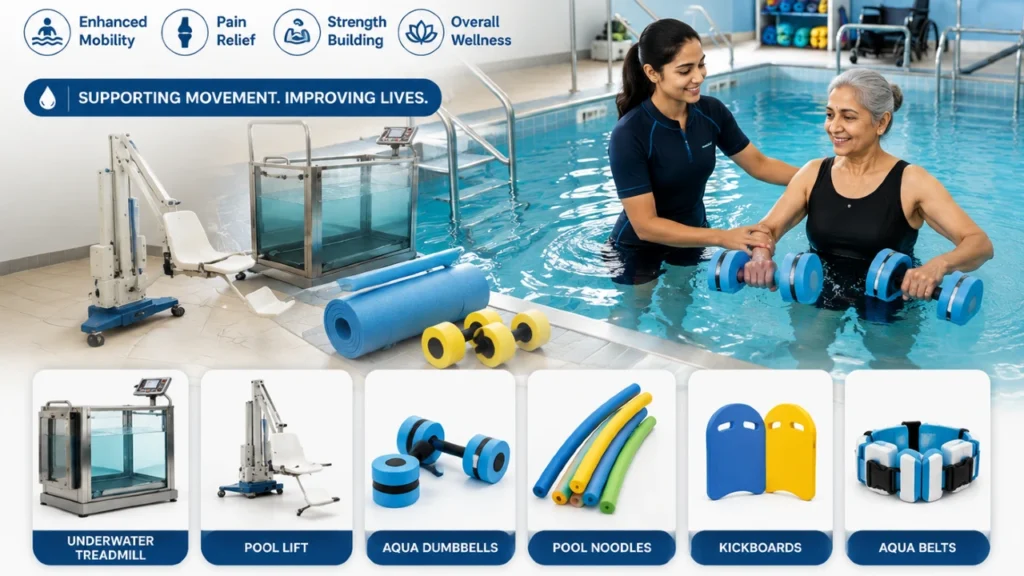
Rehabilitation centers across India are seeing a shift in who walks through their doors. More post-surgical patients, more stroke survivors, more elderly patients with joint pain, more children with developmental delays. Land-based physiotherapy can only do so much for a lot of these cases — and that’s exactly where hydro therapy equipment has started to earn a permanent place in clinic planning rather than being treated as a luxury add-on.
What Hydrotherapy Equipment Actually Does
Hydrotherapy works because water changes the rules, of movement. Buoyancy takes weight off the joints, resistance builds strength without too much strain, and warmth helps muscles ease up before they’re actually asked to do anything more demanding. None of this needs to be complicated to explain to a patient — once someone feels how much easier it is to stand, walk, or stretch in water compared to on land, the value is obvious.
This is why hydro tools for rehabilitation are increasingly used alongside, not instead of, conventional physiotherapy. For example, a patient who can’t quite bear weight on a fractured ankle can rehearse walking mechanics in a pool, weeks before trying to do the same thing on dry ground. Someone recovering from a stroke can also practice balance and coordination in water where a slip or stumble doesn’t come with the same consequence you might see on a clinic floor.
Core Equipment Categories for a Rehab Center
A center building out hydrotherapy capability usually needs to think across a few distinct categories, not just one big purchase.
Pools, tanks, and baths
This is the foundation — whirlpool tanks, contrast baths, and full hydrotherapy pools designed for therapist access on all sides. These are the highest-cost, most permanent decisions, usually tied to plumbing and space planning from day one.
Mobility and gait equipment
Underwater treadmills and static aquatic cycles allow patients to rebuild walking patterns and cardiovascular fitness. It’s often a little gentler since there’s a smaller amount of joint stress compared to land-based sessions.
Support and safety equipment
Pool evacuation stretchers, transfer aids, and foam collars matter as much as the pool itself — particularly for centers treating elderly or neurologically impaired patients who need extra support getting in, out, and through a session safely.
Resistance and exercise accessories
Kickboards, pool noodles, weighted cuffs, and weighted aquatic rings turn what would be a plain pool into a more structured exercise setting. They’re usually lower cost, pretty portable, and they let a therapist adjust resistance and difficulty without needing a totally separate piece of equipment for every single movement.
Pediatric and sensory aquatic tools
For centers working with children — whether for motor delays, sensory integration, or general developmental therapy — floating toys, baby floats with support straps, and lighted bath toys aren’t just play. They keep a child engaged long enough for a therapist to work on the actual movement goals underneath the fun.
Why the Category Split Matters
Most clinics don’t buy everything at once, and they shouldn’t. Pools and tanks are infrastructure decisions — they get planned once, usually with an architect or contractor involved, and they’re not easy to upgrade later. Accessories and tools are a different kind of decision entirely: they can be added gradually, swapped out as a center’s patient mix changes, and reordered without disrupting anything structural.
This is exactly where a lot of centers go wrong. They sink their entire budget into the pool and have nothing left for the resistance tools, support aids, or pediatric equipment that actually get used in every single session. A pool without the right accessories is just a heated room with water in it.
What to Look for Before Buying
A few practical checks matter more than they get credit for.
Material safety
Still, anything that ends up in a therapy pool has to handle constant chlorine exposure, plus repeated sanitizing, without slowly falling apart. Cheap foam or plastic accessories that degrade in just a few months can end up costing more later, even if the first price looked good, because they need replacement so often.
Space and plumbing realities
Fixed equipment like tanks and pools needs real planning — drainage, water heating capacity, and floor load are not afterthoughts. Portable accessory equipment carries none of that overhead, which is part of why it’s the easier starting point for centers still building out their hydrotherapy offering.
Buying in phases
Centers don’t need to commit to every category in year one. A reasonable sequence is support and safety equipment first, since that’s non-negotiable for patient safety, followed by resistance accessories, with pool or tank infrastructure planned separately once the clinical demand and budget are both clear.
Where the equipment comes from
This is where a lot of Indian rehab centers run into friction. Importing hydrotherapy equipment isn’t just expensive, it’s slow — and when something breaks, waiting weeks for a replacement part from overseas isn’t a workable position for a working clinic. This is exactly the gap that local hydrotherapy equipment suppliers are increasingly filling. Suppliers like Keeiko, based in Mumbai, carry a dedicated aquatic therapy range — floats, kickboards, weighted cuffs, foam collars, baby floats, and sensory aquatic toys — built for the accessory and tool side of a center’s setup, with the kind of local stock and support that importing simply can’t match.
For centers searching Hydrotherapy Equipment India or comparing Hydrotherapy Equipments online, the smartest move is usually to separate the two purchasing tracks early: get quotes and timelines locked for any fixed pool or tank installation, and build the accessory and tool kit through a supplier who can restock quickly and support the smaller, frequently-used items session after session.
Conclusion:
Hydrotherapy is no longer a specialty offering reserved for large hospitals. As more rehabilitation centers across India treat orthopedic, neurological, geriatric, and pediatric patients side by side, water-based therapy has become one of the more practical ways to expand what a clinic can offer without expanding its risk. The equipment doesn’t need to be elaborate to work — it needs to be chosen deliberately, bought in the right order, and sourced from suppliers who understand what a working rehab center actually needs day to day.