
There’s a moment every occupational therapist knows well — when a patient who couldn’t button their own shirt last month does it without thinking. No fanfare. Just a quiet, ordinary thing that used to be impossible. Tools like TalkTools Oral Motor Tools have shown what’s possible when the right equipment meets a clear clinical goal in speech therapy. The same is true here. The best occupational therapy aids aren’t impressive-looking gadgets. They’re the things that make a regular Tuesday morning feel manageable again.
What occupational therapy Aids Are Actually For
Occupational therapy is about daily life — getting dressed, eating a meal, brushing teeth, moving around a home safely. Most people don’t think about how many small physical decisions go into each of those tasks until one of them stops working. A stroke. A fall. A child who’s never developed the grip strength to hold a pencil properly. A teenager with autism who finds the sensory experience of getting dressed genuinely overwhelming.
That’s where occupational therapy aids come in. Not to replace what the person can do, but to meet them where they actually are — and give them a way to do the thing themselves. A sock aid isn’t a concession to limitation. It’s what lets someone start the day without needing to ask for help.
The Occupational Therapy Tools That Come Up Most
Dressing and grooming
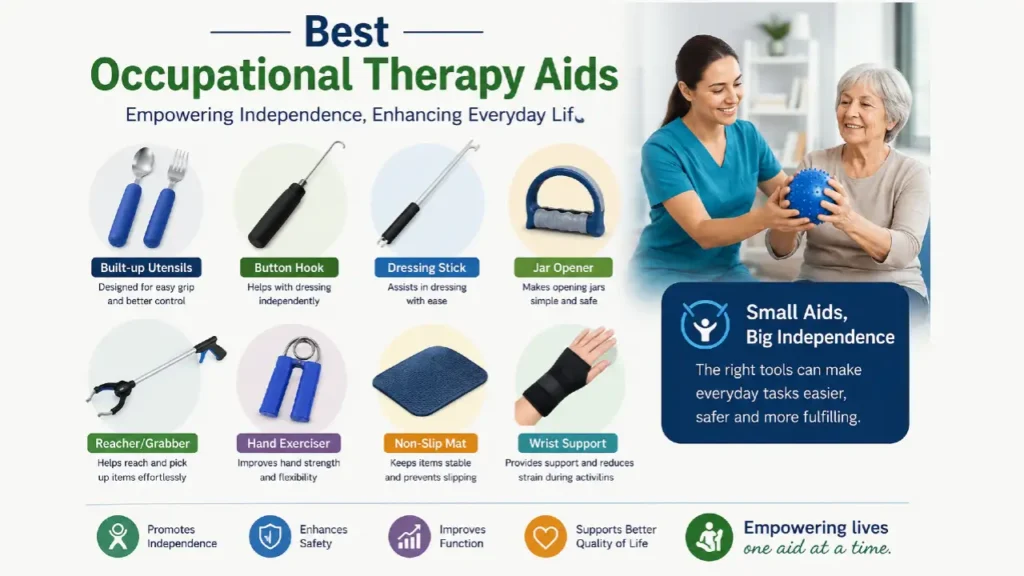
These are the tools most people encounter first — and for good reason. Button hooks for hands that can’t manage fine pinching. Zipper pulls for reduced grip. Long-handled shoe horns and sock aids for anyone who can’t bend forward comfortably. Dressing sticks to pull clothing on and off without needing full shoulder range.
On the grooming side: built-up toothbrush handles, long-handled combs and hairbrushes, and adapted nail care tools. The principle across all of them is the same — change the tool to fit the person, not the other way around. These are core Occupational Therapy Tools & Supplies in almost every rehab, elderly care, and post-surgical setting.
Feeding and mealtimes
Weighted utensils help control tremor — common after stroke or with Parkinson’s. Plate guards stop food sliding off the edge. Non-slip mats mean a bowl stays put when only one hand is available. Rocker knives and ergonomic openers make food preparation possible for people with significantly reduced hand strength.
This category matters beyond convenience. Patients who can’t manage mealtimes independently tend to eat less, with real consequences for recovery and general health. Getting mealtime aids right is clinical, not just practical.
For children with autism
The picture is more layered here. Many autistic children and adults aren’t just working on the physical side of daily tasks — they’re dealing with sensory experiences that make ordinary activities genuinely hard to tolerate. Getting dressed isn’t just a fine motor task when the texture of fabric is distressing. Eating isn’t just about utensil grip when certain food textures trigger a strong response.
Good occupational therapy equipment for autism works on both fronts. Dressing toy frames let children practice buttons, zips, and laces in a calm, low-stakes format — separate from the stress of actually getting dressed. Weighted blankets and compression vests help regulate the sensory system before other tasks begin. Sensory brushes, fidget tools, and therapy swings address the nervous system’s need for input in a structured way.
Keeiko — which has been supplying therapy equipment to clinics and schools across India since 2011 — carries several of these: dressing toy frames, T-swings, tramble ramps, and sensory integration equipment used in OT programmes for children with autism and developmental delays. For therapists building out their occupational therapy equipment catalog for pediatric caseloads, having a local supplier who stocks these reliably makes a real operational difference.
Hand strength and fine motor tools
So much of daily life runs through the hands. And when grip, pinch, or fine motor coordination is compromised — through injury, surgery, arthritis, neurological change, or developmental delay — the knock-on effects are wide.
The range of occupational therapy tools for hands reflects this: therapy putty in graduated resistance levels, grip trainers, peg boards, lacing activities, pencil grips, finger spacers. These aren’t just rehab tools — they’re used with children who are still building fine motor skills, adults recovering from wrist or hand surgery, and older patients managing progressive conditions. Hand function responds well to the right structured practice, at almost any age.
Also Read: Benefits of Occupational Therapy for Children
Bathroom and mobility
Grab bars, tub benches, non-slip mats, removable showerheads, long-handled sponges, reachers, transfer boards. These are the tools most associated with elderly patients and post-surgical recovery — but they serve anyone whose balance or mobility has changed, even temporarily.
A reacher by the laundry basket isn’t a permanent statement about someone’s abilities. It’s what lets them do their own laundry right now, while recovery is still in progress — which matters more than people tend to give it credit for.
Choosing the Right Occupational Therapy Aid for the Right Person
The mistake most people make when putting together an occupational therapy equipment catalog is starting with the product list rather than the patient. Every aid exists to close a specific gap between what someone can do and what they need to do. The right starting point is always: which task is failing, and what’s the physical reason it’s failing?
Reduced grip points toward built-up handles, weighted utensils, and grip trainers. Limited range of motion points toward reachers, dressing sticks, and long-handled tools. Sensory dysregulation points toward compression, weighted items, and sensory integration equipment. Sequencing difficulty in children points toward structured practice tools like dressing frames.
The OT assessment does this mapping — but having the right equipment available to act on it is a separate question. For clinics and schools across India, Keeiko has become a reliable answer to that question. Their OT range covers sensory integration, fine motor tools, adaptive dressing equipment, and pediatric therapy products. Therapists already ordering speech therapy or aquatic therapy equipment through Keeiko will find the OT catalogue sits naturally alongside what they’re already sourcing.
A Final Note
The tools in this category don’t get much attention outside of therapy circles. They’re not dramatic. A dressing stick isn’t going to make a headline. But for the person who used it to get dressed by themselves for the first time in six months, it’s not a small thing at all.
That’s what good occupational therapy aids do — they give ordinary moments back to people. Choosing them carefully, sourcing them reliably, and matching them to the specific person in front of you is the whole point.