
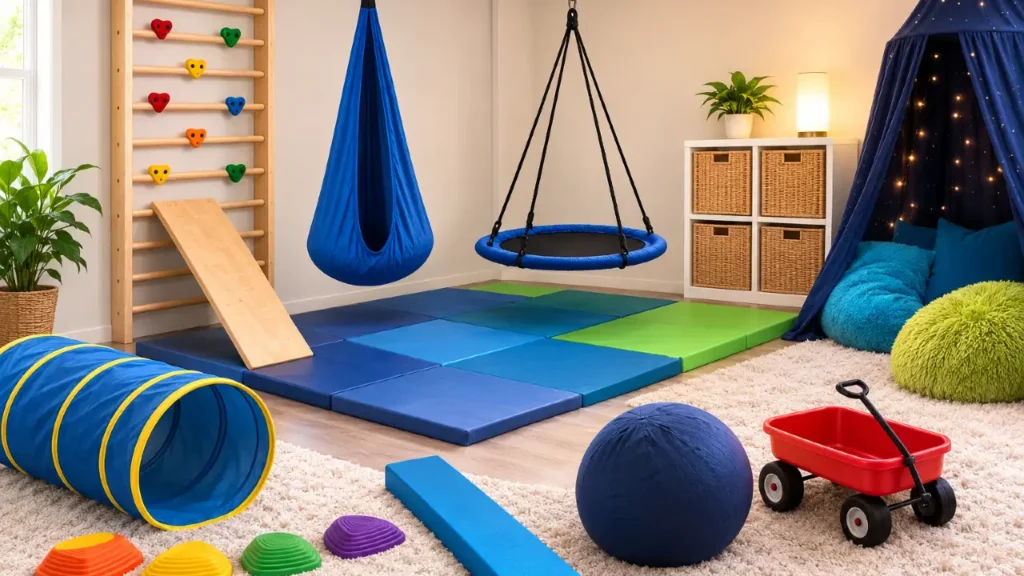
You’re the parent who has noticed your child frequently jumping on the sofa, spinning in circles hitting the cushions or covering their ears when the noise is loud. Some children enjoy these activities. Other children become overwhelmed by what they see, hear or touch every day. In those situations, a home sensory gym can make a difference for your child.
The benefit of a home gym is that you do not have to get a whole room or any expensive equipment for it. As long as the area is well organised, it can give your child the opportunity to move around explore, calm themselves and learn to cope with their emotions all within the familiarity of your own home t, the home sensory gym.
So what is a Home Sensory Gym?
A home sensory gym that is appropriate for children satisfies your child’s needs by means of play and physical activity. Unlike a play area, each activity or piece of equipment in the home gym has a purpose. Some activities in the home gym aid your child in moving. Others aid your child in becoming aware of their body. Some activities in the home gym are meant to help your child relax when they are feeling overwhelmed in the home sensory gym.
Children with autism, ADHD, sensory processing difficulties or developmental delays usually obtain benefits from a home gym. Sensory play is not merely appropriate for children who have been given a diagnosis. Since all children learn through movement and by means of experience these activities in the home gym are advantageous to their development in the home sensory gym.
It is also advisable for therapists to carry out activities at home because children generally do better when the therapeutic methods become part of their routine with the home sensory gym.
Reasons for Building a Home Sensory Gym?
Therapy does help. Most families arrange to have therapy twice a week and in the case where there is a home gym, the children can get the stimulation they need when they need it from the home sensory gym.
It is common for parents to notice that once their children take part in activities regularly, they get used to settling down after school, focus when doing their homework, sleep peacefully and have fewer outbursts when managing their emotions. The benefit of having ten minutes of movement every day is greater than the benefit of having a therapy session with the help of the home gym.
Buy Best Sensory Toys For Kids
Another benefit is that the siblings usually take part in the therapy activities before the family moves on to some playtime in the home gym.
First Step: Choose a Safe Space
There is no need to worry about not having a room since a large number of families are able to make a home gym in the living room, bedroom or even in part of the hallway.
The first thing to do is to make sure that the area is safe for the home gym. To do this, you should use foam mats, carpets or some other type of flooring to catch any falls. Furniture with edges should be placed away from the play area to leave room for movement in the home gym. The space must be well ventilated. While your child is playing you might want to put in some cushions or padding on the walls for protection in the home gym.
A room that is used every day is better than one that is only used occasionally for the home gym.
Second Step: Choose Equipment That Matches Your Child
A mistake that parents make is to buy all the products they come across online. The best home sensory gym is not the one that has the equipment; it is the one that has been designed with your child’s needs in mind for the home sensory gym.
If your child likes moving you might consider buying them a therapy swing, a hammock swing, a mini trampoline or a balance board for the home gym.
If your child enjoys activities that involve applying pressure or are heavy, then items such as crash cushions, bean bags, resistance bands, therapy putty or a weighted lap pad could be useful in the home gym.
Children who take pleasure in exploring textures usually also enjoy bins containing rice, beans or kinetic sand. Other items that promote exploration include mats, fidget toys and sensory balls for the home gym.
It is just as important to have a place where your child can slow down, and soft cushions, suitable lighting, noise-cancelling headphones or a bubble lamp can all help in setting up an atmosphere when a break is needed in the home gym.
You need not buy all the items at once. Rather, start by purchasing a few of them. Then discover what your child likes before increasing the number of items for the home gym.
Third Step: Use It Every Day
It is better to carry out activities every day than to wait for a time before doing them in the home gym.
It will not help to try to fit in activities when your child’s already overwhelmed. Spending a minute on movement before school can assist your child in preparing for the day while sensory play after school can help your child get rid of the energy in the home gym. Quieter activities before bedtime can also help your child to wind down with the help of the home gym.
Many families also find that having a routine enables them to keep up these habits, especially when it comes to children or individuals who like to know what is going to happen in the home gym.
Fourth Step: Let the Space Grow With Your Child
As your child’s interests and sensory needs change so should your home sensory gym.
You should again note which activities your child takes pleasure in and which ones they rarely take part in. Although it may be difficult for them when it is time to change their equipment, there is no reason for them to feel bad about getting rid of items that are no longer useful in the home gym.
It is impossible to complete the construction of a home gym since it has to be modified as your child grows, and the home sensory gym needs to grow with your child.
Fifth Step: Work With Your Occupational Therapist
A home sensory gym may indeed be helpful. However, it should not be used as a substitute for therapy. As a supplement to the home sensory gym.
If you have your child getting therapy, it would be a good idea to ask the therapists’ advice before buying any equipment, as personal recommendations can help ensure that the activities you carry out at home are in line with your child’s therapy goals for the home gym.
Final Thoughts
A home sensory gym need not look like a therapy clinic to be effective. On the whole, le the effective ones is the simplest. What is important is to make a place where your child feels comfortable, safe and able to move in a way that helps them to control both their body and their emotions in the home gym.
Start on a scale by focusing on the elements that work and modify your approach as your child grows older. In this way, this small area of your home can gradually become a place where your child builds up their confidence, improves their motor skills and learns to understand their needs with the help of the home gym.
Should you be unsure as to which activities to start with the occupational therapist can help you to discover those that are suitable and to identify the equipment for your child for the home sensory gym. Reaching out to experienced teams like Ekansh Abilitation Centre is a good starting point if you’re looking for personalised guidance. By following their advice and being patient, you will be able to set up an environment that supports your child’s development well after the therapy sessions have finished, with the home sensory gym.
(Senior Occupational Therapist and Certified Sensory Integration and Oral Placement Therapy Expert)