
Usually, when a child first goes to a therapy clinic parents think that therapy begins with choosing the swing, balance board or sensory toy. In reality, effective therapy begins before that; it begins with getting to know the child.
When you are selecting therapy equipment, you should not go for the newest or most costly items but instead should choose equipment which fits the particular needs, strengths and therapy aims of the individual child; this is the reason why an experienced and qualified occupational therapist should be the one to decide, since they know how children develop and think.
At the Ekansh Abilitation Centre, the programme of therapy for each child starts with an assessment, and the equipment is carefully chosen so that it may help the child to achieve results rather than just keeping them occupied.
The Importance of Choosing the Right Occupational Therapy Equipment
Every Child Has Different Therapy Needs.
Even if children are given a diagnosis, each and every one of them is different.
For example, two children with autism could have sensory needs; one might enjoy moving about and spinning as well as climbing and jumping while the other might avoid any movement and become anxious when sitting on a swing. Children who have ADHD, cerebral palsy a developmental delay, Down syndrome or sensory processing difficulties all have their strengths and requirements.
This is the reason why therapists take the time to understand a child’s motor skills their needs, balance, coordination, posture, attention, method of communication and daily living skills before deciding on which occupational therapy equipment to use.
Also Read: Best Occupational Therapy Aids to Improve Daily Living Skills
Even if this assessment is not carried out the best equipment could still fail to function.
Assessment Always Comes Before Equipment
One of the duties of an occupational therapist is to observe and understand the child. During the evaluation, the therapist closely notes how the child moves, how the child reacts to input how the child follows instructions, how the child interacts with the environment and how the child performs age-appropriate activities. The therapist also carries out some assessments. Has a conversation with the parents in order to determine the child’s individual needs.
After the therapist has gathered this information, they will choose the occupational therapy equipment that will best support the child’s development.
If anybody asks, ‘Which occupational equipment should we use?‘ experienced therapists reply, ‘What kind of things does this child need to learn and what equipment will help them to achieve those things?’
That is why therapy turns out to be effective.
Different Goals Require Equipment
The occupational equipment used in therapy has a specific purpose.
A therapist could use balance boards, stepping stones, therapy balls or obstacle courses to help a child to improve his or her balance and coordination.
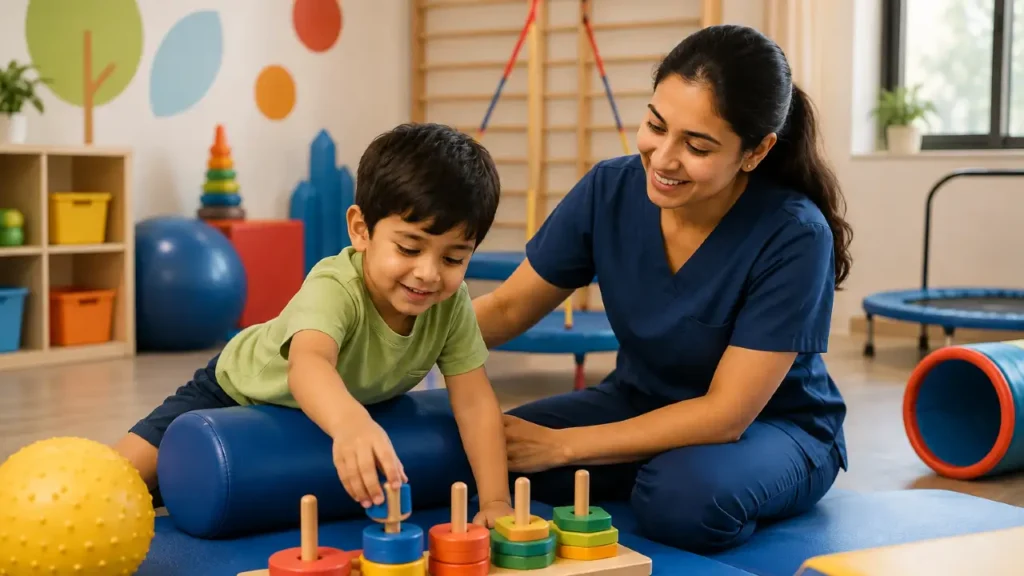
A therapist can help children to develop their core strength and posture by using therapy rolls, peanut balls, climbing equipment and suspended activities since these not only strengthen the children but also manage to keep them interested.
Children who have difficulties with processing can benefit from activities which have been carefully planned, for example those using swings, crash mats, weighted objects, tactile materials or deep-pressure exercises. The activities are based on the child’s needs rather than on their personal preferences.
In order to aid the development of their motor skills, children can use therapy putty, pegboards, tweezers, lacing activities or hand-strengthening tools so as to improve their hand function for the purpose of writing, dressing and looking after themselves. We should always aim at helping the child to develop the skills needed for life, not use the equipment just for variety.
Also Read:
Why Experience Makes a Difference
Although a great many of the therapy products available claim to be suitable for every child, they should by no means replace a professional assessment.
An experienced occupational therapist cannot decide what equipment to use. Can they work out when to use it, how to use it, or for how long? The effect of the therapy swing may be to help a child or instead to over stimulate them depending on how it is used. In each case—whether it be weighted items, resistance exercises or vestibular equipment— judgment is needed to ensure that the equipment is both safe and effective.
Not knowing what the equipment is for can have the effect of delaying progress. May even make behavioral and sensory difficulties worse.
That is why parents should obtain advice from a therapist before buying therapy tools.
Also Read: Benefits of occupational therapy for children
The Importance of a Child-Centered Approach
It’s not just about having the equipment to have therapy.
Children are most effective in their learning when they are motivated, comfortable and in a secure state. Experienced therapists modify the activities in line with the child’s interests while ensuring that the therapeutic goals are not abandoned.
A child who has a liking for animals can practice their balance by taking part in an obstacle course with an animal theme whereas a second child who enjoys cars can develop their motor skills by means of games based on vehicles. The equipment remains the same; it is the way in which it is used that is changed so as to keep the child interested.
As the emphasis is placed on the children, en their level of participation increases and they are thus able to gain confidence and a sense of independence
Also Read: Benefits of Occupational Therapy Equipment
Can parents buy occupational therapy equipment to use at home?
Many parents would like to carry out the therapy activities at home and great benefit will result provided they are carried out properly.
It would not be suitable to purchase occupational therapy equipment just because it’s popular in the media or because another parent has suggested it.
Ask your child’s therapist about their objectives; they may be able to recommend some low-cost equipment which will help complement the therapy received at the clinic and that will fit comfortably in your home.
When household items are directed in a way by professionals they can be just as effective as specialised equipment.
Quality Therapy Is About Purpose, Not Quantity
It is generally the view of parents that if a clinic has a kind of equipment, it will give better therapy; yet the effectiveness of the therapy depends more on the therapist’s knowledge than on the number of tools the clinic has.
Experienced therapists know the ways in which they can make use of resources in order to achieve various developmental goals; they continuously change the activities, adjust the difficulty level and watch the child’s reaction throughout each session. By using this method, therapy is guaranteed to be meaningful, interesting and focused on specific objectives.
Final Thoughts
Choosing occupational therapy equipment entails more than picking up colourful toys or sensory items; it is a carefully considered clinical decision that is based on a detailed assessment, professional knowledge and the individual needs of each child.
When equipment is carefully chosen it can be used to improve motor skills, sensory processing, independence, confidence and participation in life. It is just as important to realize that the equipment on its own does not cause progress; it is the way in which it is used that makes the difference.
Should you decide to have your child start therapy, you must depend on the knowledge of a therapist who is in a position to decide on the most appropriate occupational therapy equipment and to draw up a personalised intervention plan. Your child will be able to reach their potential and at the same time make the most of therapy if they receive proper guidance, carry out a variety of activities and have consistent support.
Explore & Buy Quality Occupational Therapy Equipment and Tools Online at Keeiko
(Senior Occupational Therapist and Certified Sensory Integration and Oral Placement Therapy Expert)