
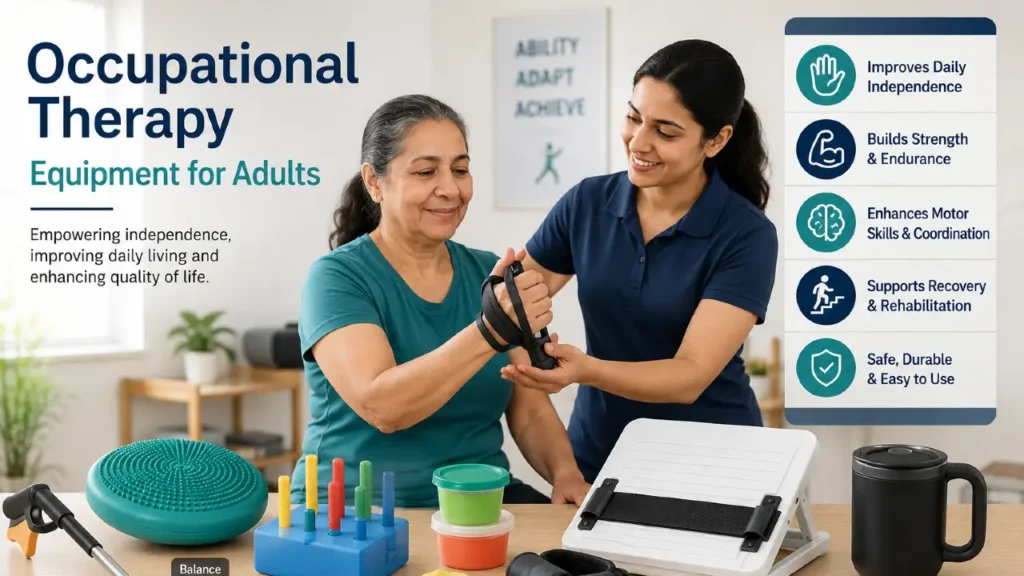
There is something nobody really prepares you for when someone you care about — or you yourself — loses the ability to do everyday things. Like getting dressed, making breakfast, holding a pen, gripping a mug. These aren’t dramatic milestones, they’re just life. And when they become difficult or impossible, the loss is felt in ways that go far beyond what you can point to physically.
That space is where occupational therapy works. Not only rehabilitation in the clinical sense, but the actual recovery of a person’s capacity to live their life with dignity and independence. And the equipment that backs up that whole process — the tools , assists, and devices used during sessions and at home — plays a bigger part than most people realize.
This guide takes apart the main categories of occupational therapy products for adults: what they are, who they suit, and what you should weigh up before buying.
What Does Adult Occupational Therapy Actually Cover?
A lot of people still connect OT with children , like sensory processing, developmental delays, school-based help. But occupational therapy for adults is just as necessary, and in some ways even more complicated.
Adults reach OT through all sorts of pathways: stroke, traumatic brain injury, Parkinson’s disease, multiple sclerosis, spinal cord injury, rheumatoid arthritis, post-surgical recovery, chronic pain, or simply that slow functional fade that can come with age. Each one affects the body — and sometimes the mind too — in different ways. So adult occupational therapy equipment covers a massive range, and what helps one person may be completely off for someone else.
The common goal is still the same though: supporting someone to do the everyday things that matter to them, as independently as possible.
The Main Categories of OT Equipment for Adults
Fine Motor and Hand Function Tools
If you had to pick one area where adult OT does the most visible work, it would probably be the hands. Grip strength, pinch strength, finger coordination, are basically the backbone of almost everything: writing, eating, using a phone, doing up a button. For stroke survivors and people living with arthritis, plus anyone recovering from a hand or wrist injury , these skills often have to be rebuilt from scratch.
Therapy putty is one of the more popular occupational therapy devices for adults in this category, it shows up in different resistance grades and it lets you focus work on both strength and dexterity, at the same time. Finger exercisers, hand grippers, pegboards, and fine motor manipulation kits with everyday objects like buttons, zips, and fasteners are also standard. The goal isn’t just strength — it’s the neuromuscular pattern of precise, coordinated movement.
Upper Limb and Shoulder Rehabilitation Equipment
Shoulder pulleys, overhead exercise bars, arm slings, and resistance bands are among the most commonly used adult occupational therapy equipment for upper limb recovery. After a stroke or shoulder surgery, regaining functional reach is a long process — and consistency matters more than intensity. These tools make that consistency possible, especially when they’re incorporated into a home programme that runs between clinic sessions.
Arm skates and deltoid aids come in where active movement is limited, allowing assisted and passive movement to begin building the motor pattern before the muscles can take over independently.
Daily Living Aids and Adaptive Equipment
This is the category that connects OT most directly to real life — and for many adults in recovery, it’s where the most meaningful progress happens. Occupational therapy aids for adults in this area include:
- Dressing aids — button hooks, long-handled shoe horns, sock aids, elastic laces — for anyone with limited grip or reach
- Eating and drinking aids — weighted cutlery, angled spoons, plate guards, non-slip mats, and adapted cups — for managing tremor, weakness, or coordination difficulties at mealtimes
- Bathing and grooming aids — long-handled sponges, suction grab rails, bath seats, adapted razor holders — for staying safe and independent in the bathroom
- Kitchen and cooking adaptations — jar openers, one-handed chopping boards, suction base tools, one-handed tin openers — for returning to independence in the kitchen
It’s easy to underestimate how much these things matter. The ability to make your own cup of tea, to get dressed without asking for help, to cook a simple meal — for someone who’s been unable to do these things, they’re not small wins. They’re the measure of recovery.
Cognitive and Perceptual Rehabilitation Tools
Stroke and brain injury don’t only affect the body. Attention, memory, processing speed, spatial perception, problem-solving — all of these can be significantly impacted, and all of them fall within OT’s scope.
Cognitive rehabilitation tools used in adult OT include sequencing cards, memory matching games, number and letter sorting tasks, construction and assembly activities, and clock-reading exercises. These work alongside computer-based programmes in many settings, but hands-on tabletop materials remain central — particularly for clients who benefit from tactile engagement that screen-based tasks can’t replicate.
Sensory Processing and Desensitisation Equipment
Adults recovering from nerve injuries, burns, or complex regional pain syndrome (CRPS) often need systematic sensory retraining. The nervous system’s response to touch has been disrupted, and it needs to be gradually recalibrated. Desensitisation kits — with textures ranging from soft cotton to firm bristles, plus vibration tools — allow this to happen in a controlled, progressive way.
For people with reduced or absent sensation — following spinal cord injury, for example — sensory stimulation tools serve a different purpose: rebuilding awareness and reducing the risk of pressure injury or burns from undetected contact.
Seating, Positioning, and Pressure Care
For adults with limited mobility, this isn’t just about comfort — it’s clinical. Poor positioning causes pressure sores, postural deformity, and can compromise breathing. OT-grade pressure relief cushions, postural wedges, lateral trunk supports, and specialist seating systems are essential equipment in long-term care, home care, and post-acute rehabilitation settings.
Getting seating and positioning right is one of the most impactful — and most overlooked — aspects of adult OT, particularly for people who spend significant time in a chair or bed.
Splinting and Orthotics
Thermoplastic splinting materials are a standard part of adult OT practice — used to rest injured joints, maintain range of motion, prevent or correct deformity, and support functional positioning of the hand and wrist. Resting hand splints, wrist cock-up splints, and dynamic extension splints are among the most common types, with the right choice determined entirely by the individual’s presentation.
Pre-fabricated splints are also available for less complex presentations — carpal tunnel syndrome, trigger finger, mild wrist sprains — where a custom-fabricated option isn’t clinically necessary.
Exercise and Strengthening Equipment
Resistance bands, foam rollers, stability balls, balance boards, and parallel bars feature in many adult OT programmes — not just physio. The difference is context: when OT uses strengthening and balance work, it’s in the specific service of functional performance. Building enough leg strength to get in and out of a chair safely. Developing enough core stability to reach into a cabinet without losing balance. The equipment is similar; the application is different.
Occupational Therapy Equipment for Home Use
One of the most important concepts in OT is carryover — the idea that what’s worked on in a session needs to be practised consistently at home for real progress to happen. A once-weekly clinic appointment is never going to be enough on its own. Home programmes are always part of the plan.
The tools used at home are usually a carefully chosen subset of what’s used in the clinic — safe to use independently, easy to integrate into daily routines, and appropriate for the person’s current ability level. Therapy putty, resistance bands, adapted cutlery and kitchen tools, grab rails, fine motor practice kits — these are the kinds of occupational therapy equipment for home use that make the difference between a programme that works and one that doesn’t.
In India, accessing quality adult occupational therapy equipment has traditionally been difficult — either expensive imports or lower-grade alternatives that don’t hold up to regular use. Suppliers like Keeiko have changed that. They stock a comprehensive range of OT equipment for adults across therapy categories — from tactile and fine motor kits to therapy tables, dumbbell racks, and sensory products — and serve both individual families and institutions including clinics, hospitals, and special schools.
What types of equipment are commonly used in adult occupational therapy?
It’s a wider range than most people expect. On any given day, a therapist might be using therapy putty for hand strengthening with one client, shoulder pulleys for post-stroke upper limb rehab with another, adaptive cutlery for someone relearning to eat independently, and a balance board for fall prevention work with a third. Cognitive tools, sensory desensitisation kits, splinting materials, pressure care cushions — all of these sit within adult OT. The specific tools used for any one person depend entirely on their diagnosis, their functional assessment, and what they’re working towards.
What should I consider before buying occupational therapy equipment for an adult?
A few things are worth thinking through carefully before purchasing:
What specific functional goal is this equipment meant to support? Equipment purchased without a clear deficit in mind often ends up unused.
What’s the person’s current ability level? Tools that are too easy won’t drive progress. Tools that are too challenging can cause frustration or injury. This is where an OT assessment makes a real difference.
Will it be used independently or with supervision? This affects what’s appropriate for home use and what needs to stay in a clinical setting.
Is the quality clinical grade? Medical-grade occupational therapy aids for adults are built to withstand frequent, repeated use and are made to tolerances that consumer alternatives often aren’t. Cheap substitutes often cost more in the long run.
Where can you reliably source it in India? For clinics and families looking for consistent access to professional-grade OT equipment, suppliers like Keeiko — who have been working with healthcare institutions and therapy professionals across the country for over a decade — are worth knowing about.
Conclusion
No guide to adult occupational therapy equipment is a substitute for an actual OT assessment. The tools covered here work when they’re the right tools for the right person at the right point in their recovery. They don’t work when they’re picked off a list without that context.
If you’re supporting an adult through recovery, or managing a long-term condition yourself, the starting point is always a qualified occupational therapist — someone who can assess where things actually stand, set goals that are genuinely meaningful, and put together a programme where the equipment serves the person, not the other way around.