
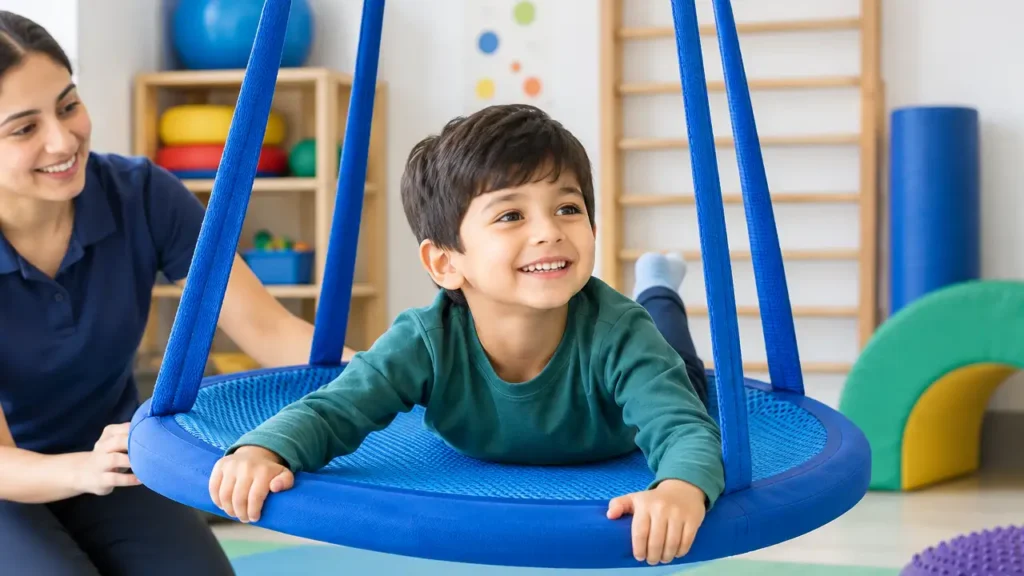
When you enter a therapy clinic, you will probably notice a swing.
You may see a child sitting on a platform swing and another child lying in a hammock swing, with a therapist gently moving the child while talking. To some parents, a swing may appear to be just a toy. However, in the context of therapy, it can have an important role.
I have on many occasions noticed that children are more at ease with an activity when some kind of movement is included; a child who is refusing to sit down at a table can suddenly become willing to take part after a period of movement.
A swing is capable of helping to improve a child’s balance, body awareness, coordination, posture, attention and sensory regulation. If an occupational therapist with the necessary knowledge chooses and uses the swing in accordance with the child’s specific needs, the swing becomes much more than just a toy. This is the reason why occupational therapy equipment such as swings is usually available in children’s therapy clinics.
Why is movement so important for children?
Children pick up a great deal of information about their bodies as a result of moving. For instance, simple activities such as climbing stairs, jumping, running, balancing or sitting on a chair help the brain to learn where the body is and how its various parts work in conjunction with one another.
A system is involved in this matter. This system enables us to understand movement, helps to keep our balance, and also contributes to the maintenance of posture as well as the control of our movements.
Swinging provides the body with stimulation. The therapist is able to give a child new movement experiences by selecting the kind of swing and considering how the child is positioned and how the swing moves, while at the same time observing the child’s reaction. This is the reason why swings can be used as tools in therapy sessions.
A Swing Is Not Just for Swinging
One thing parents should keep in mind is this:
A swing is not generally used in therapy simply because the child likes swinging; there is usually a particular reason why the therapist has chosen it.
Swinging might serve as a warm-up before sitting down to eat for one child, while for another it could form part of an obstacle course intended to enhance motor planning. In the case of a child who has difficulty with control, the therapist may put them in a certain position on the swing in order to build up their strength and stability.
Swings Can Support Sensory Regulation
It appears that some children have a constant desire to move. They could jump on furniture, run about the house, spin a lot or have difficulty remaining seated while taking part in activities.
The therapist looks at how the child responds and on this basis decides what sort of swing and movement will be most suitable. The speed, direction, length of time and position of the child can all be altered according to the way the child reacts.
That is the reason why occupational therapy equipment should not be selected simply because it looks exciting or because it is popular online; the effects of the same swing will depend on how and why it is being used.
Supporting Balance and Body Awareness
Don’t you find that your child frequently hits furniture or has difficulty in judging how near they are to objects?
Children can develop an awareness of their bodies and gain control of their posture by taking part in activities involving movement and by changing their body position.
Because the surface under them is in motion, swing activities make it more difficult for a child to remain still. It is even more difficult to reach for objects when a child is sitting, kneeling or lying on a swing.
For example, a therapist could ask a child to reach for objects while remaining balanced on a swing, thus helping the child to improve his or her balance, shoulder stability, visual-motor coordination and motor planning.
The child could think that all they are doing is having some fun. At the same time, the therapist is quietly observing the skills that are being used and how well they are performing.
Shop Lycra Swing For Occupational Therapy
Swings Can Make Therapy More Engaging
Let us be honest, children never always want to sit down and practice a skill just because they’re told it’s beneficial to them.
It is here that play becomes essential.
A child is more likely to reach, look, communicate, follow instructions or complete the task if the activity is incorporated into something they already enjoy.
The therapist can take this chance to develop the necessary skills without turning the session into a series of exercises.
For children, having fun and taking part is an integral element of the learning process. Once the child is interested in what they are doing, the therapist can then proceed with achieving the child’s goals.
Shop Rope Ladder Swing for Kids Physical therapy
Different Swings, Different Purposes
Far from it being the case that each swing provides the same experience.
The kind of swings used as part of therapy will depend on the child’s objectives, sensory requirements and motor skills. The available options include:
- The platform is useful for improving balance when reaching, for postural control and for motor planning.
- For cocoon or hammock swings: make a snug, enclosed area and use it for body-awareness exercises.
- Include exercises that improve balance, postural control, and strength.
- The disc swings enable movement in various directions and help to improve balance.
- Swings create motion and provide deep-pressure sensations according to the child’s position and activity.
The choice of swing should always be based on the child rather than on the equipment that happens to be in the clinic.
The Therapist’s Role Is More Important Than the Swing
There is a tendency for parents to think, “My child does actually enjoy swinging. Perhaps I should get one for home.”
At this stage, it is essential to seek professional advice.
Before carrying out any form of physical activity, a qualified occupational therapist examines the child’s responses, motor skills, developmental level and medical history, as well as his or her therapy goals.
They also watch how the child responds while the activity is taking place. Is the child becoming calmer and more involved? Is the child becoming excessively excited? Does the movement assist the child in carrying out the task, or does it make it more difficult?
These observations enable the therapist to decide which aspects to continue with, which to modify, and when to stop.
Which is why occupational therapy equipment should be regarded as a tool and not as a toy.
Could swing therapy be of help to every child?
There is no therapy activity that is effective for all children.
Certain children do well when they are swinging, while others may not like the kind of movement involved and might find it uncomfortable. Those children whose needs are in question may require different methods.
We don’t want every child to use a swing.
We aim to find out if movement is beneficial for the child and, if it is, then how it should be employed.
Shop Tube swing for sensory therapy
Choosing the Right Swing Equipment Matters
A swing might appear to be simple, but to use it properly, one needs knowledge and good judgment; the kind of swing, the child’s position, the direction and speed of movement, the length of time and the task involved can all affect the experience.
At the Ekansh Abilitation Centre, occupational therapy equipment is selected on the basis of the child’s individual needs and the therapy objectives. It is not a matter of having the equipment. What is important is understanding the reason for using a particular piece of equipment and the way in which it helps the child’s development.
It is particularly important in the context of therapy since the activities have to correspond with the child’s age, abilities, and personal needs.
Final Thoughts
Swings are included in therapy since a single piece of equipment can have a number of uses. The swing activities can aid in improving balance, coordination, postural control, motor planning and sensory regulation.
What makes an activity therapeutic is not the act of swinging but the therapist’s understanding of the child.
The equipment, which was used at that time, could turn a straightforward physical activity into a great opportunity for acquiring important skills.
When you see a child smiling as they are swinging during a therapy session, remember that there is going on more than simply play.
Written by Dr. Sanchita Kurhade
(Senior Occupational Therapist and Certified Sensory Integration and Oral Placement Therapy Expert)