Most parents can point to the first time worry showed up. It may have been when their child was two and still could not put words in a clear order. It may have been at four, when the words came out, but strangers could not make sense of them.
A child who knew exactly what they wanted to say but couldn’t get the sounds out in the right order. That gap between what a child is trying to communicate and what’s actually coming out — it’s one of the more quietly difficult things a family can navigate.
Speech and language therapy exists to close that gap. A good therapist matters a lot. Still, the items used in sessions and at home can shape the results more than people think. This is about those items. What they are. What they do in practice. And why the right speech therapy gear may help progress move sooner instead of dragging on.
Why Tools Matter in Speech Therapy
There’s a version of speech therapy that’s just a therapist and a child sitting across a table, practising sounds. That version works for some children. But for many — particularly those with speech delay, motor planning difficulties, sensory differences, or low oral muscle tone — verbal instruction and imitation alone isn’t enough.
The muscles involved in speech — the lips, tongue, jaw, soft palate — need to learn through movement and sensation, not just through listening and watching. Speech therapy devices for speech delay are designed to provide exactly that: physical input that helps the body understand what it’s being asked to do.
Beyond the physical side, tools also make therapy more accessible for children. A structured tool gives a child something concrete to engage with. It turns what could feel like an abstract or pressured exercise into something tangible — often something that resembles play more than therapy. That shift matters enormously for engagement, and engagement is what drives progress.
The Real Benefits of Speech Therapy Equipment
They Build the Physical Foundation for Speech
Speech is not just words. It starts in the body. A child needs strong mouth muscles, good control, and the skill to place the tongue and lips in the right spot. Without that, clear sounds do not come easily. Kids with low oral muscle tone often struggle with this step. It can show up in Down syndrome, cerebral palsy, and some speech delays where the cause is not clear yet.
Oral motor tools like bite blocks, horn kits, straw kits, and jaw grading tools give those muscles targeted, structured work. They don’t just build strength — they train the specific movement patterns that speech requires. Lip closure, tongue retraction, jaw grading, breath control: these are skills the mouth has to physically learn, and the right speech therapy equipment for children makes that learning possible.
They Add a Layer That Conventional Therapy Can’t Provide
Traditional speech therapy gives children auditory and visual input — they hear a sound modelled, they watch it being made. For most children, that’s enough of a starting point. But for children who haven’t responded to this approach after extended periods, something is often missing: tactile and proprioceptive input. The physical sensation of where the tongue is supposed to be, what lip closure actually feels like, how the jaw moves when grading between open and closed.
Speech and language therapy tools — particularly vibration tools like the Z-Vibe, and structured oral motor kits — deliver that third layer of input. For children who have been stuck at the same point for months despite consistent therapy, this is often what changes the picture.
They Make Home Practice Possible — and Sustainable
One of the most consistent findings in speech therapy research is that frequency matters. A weekly session is valuable, but it’s the practice between sessions that determines how quickly skills consolidate. The challenge is that most parents aren’t trained therapists — they need tools that make home practice structured, safe, and something a child will actually engage with.
The best speech therapy tools for kids are designed with this in mind. A horn kit that turns breath control work into blowing games. Straw kits that build tongue retraction through everyday drinking practice. Oral sensory tools that can be incorporated into the school day. These aren’t clinical devices that require clinical settings — they’re tools that work within the texture of a child’s normal day.
They Support Sensory Regulation Alongside Communication
For many children with speech delay, the communication difficulty doesn’t exist in isolation. Sensory processing differences are extremely common — oral hypersensitivity that makes anything near the mouth uncomfortable, or the opposite, a constant seeking of oral sensory input. Both affect speech, feeding, and behaviour.
Oral sensory tools — vibration devices, textured oral tools — address this directly. For hypersensitive children, they’re used as part of a gradual desensitisation process that slowly increases tolerance to touch around and inside the mouth. For children who seek oral input, they provide a structured, safe outlet that reduces the random seeking behaviour while building oral awareness at the same time.
When sensory regulation improves, the child is simply more available for the communication work. It’s not a separate track — it feeds directly into speech progress.
They Reduce Frustration for the Child
This one doesn’t get talked about enough. A child who can’t make themselves understood is often a child dealing with significant frustration — sometimes expressed as meltdowns, sometimes as withdrawal, sometimes as reluctance to try at all. The longer the gap between intent and output, the harder that frustration becomes to manage.
When the right speech therapy equipment helps a child feel the correct position, make a sound they haven’t been able to make before, or successfully use a straw or blowing tool for the first time — that’s a win they can feel. When you have the right setup, the plan feels different. Even small gains lift hope. Solid tools help those first wins arrive earlier.
They Give Parents Something Concrete to Work With
Being told to “practise speech sounds at home” is well-intentioned advice that most parents find difficult to follow. What sounds? How? For how long? When a therapist prescribes a specific tool — this straw, this bite block, this vibration device, in this sequence — it gives parents a clear framework. The uncertainty is removed. The home programme becomes something they can actually do, rather than something they worry they’re doing wrong.
That confidence matters. When caregivers feel ready, they tend to keep going. That part matters. The real test is what happens after the first few sessions, not only what is planned. With steady follow through, a programme can keep moving. If follow through drops, the plan often slows down.
Also Read: Best Occupational Therapy Aids to Improve Daily Living Skills
Types of Speech Therapy Equipment for Children
Speech therapy equipment for children covers a surprisingly wide range, and different tools serve very different purposes. Here’s a practical overview of what’s commonly used and why.
Oral Motor Tools
Horn kits, straw kits, bubble kits, and jaw grading bite blocks are among the most foundational speech therapy tools in clinical use. Each targets a specific oral motor skill — the Horn Kit builds lip rounding and breath support, the Straw Kit works tongue retraction through a hierarchy of straw resistances, and Jaw Grading Bite Blocks train the jaw to stabilise at different opening heights. The equipment is drawn from structured therapy methods such as TalkTools Oral Placement Therapy. A Speech-Language Pathologist selects the items. They also monitor use to make sure it fits the child.
Vibration and Sensory Input Devices
Tools like the Z-Vibe are widely used in both clinical and home settings. The vibration provides proprioceptive input to the oral structures — essentially helping the brain map where things are in the mouth. For children with reduced oral awareness, this is often a missing piece. The same tools, used differently, support desensitisation in children who are hypersensitive to oral touch.
Oral sensory and touch tools
Some kids want steady input in and around the mouth. Others get bothered by things that come near their lips. For both groups, the right touch based tools can change how well a plan works. Keeiko’s Tactile Kit is made for this exact need. It includes oral motor items for warm ups, for desensitising, and for step by step oral motor tasks. The goal is to help a child slowly handle more touch and build a better sense of what is happening in the mouth.
For kids who are hyposensitive, the kit can still be useful. It gives clear tactile input that the nervous system may need first. After that, real speech practice can start.
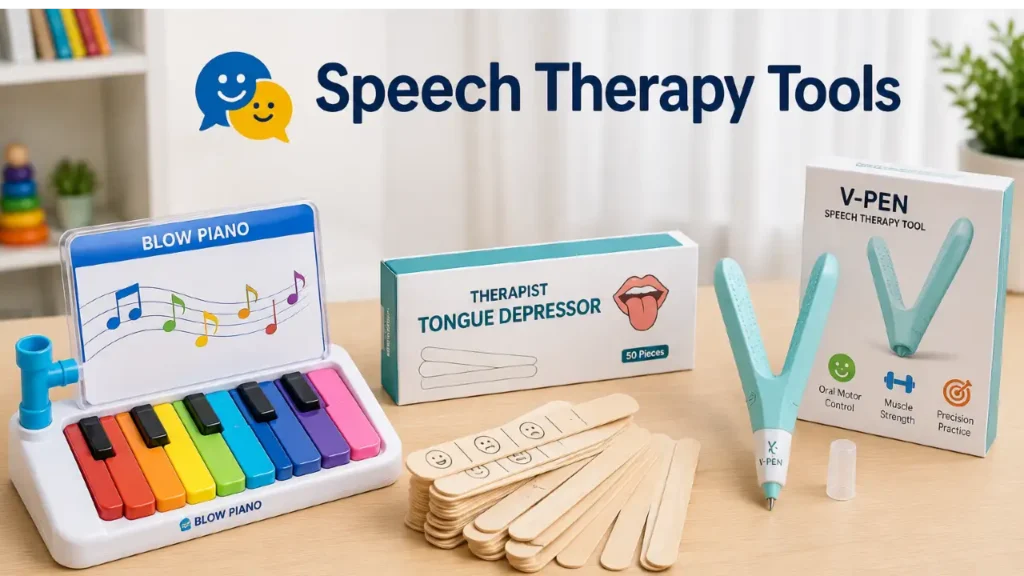
Keeiko’s V-Pen is used alongside the kit. It is an oral stimulator for speech therapy time. It aims the input at the mouth structures. With that input, the brain can form a clearer internal picture of tongue, lips, and jaw position.
These tools can matter a lot for autistic children and for kids who have sensory processing differences. Often, the sensory basics need to be in place before other goals can move forward..
Augmentative and Alternative Communication (AAC) Tools
Not all speech therapy is about producing sound. For kids who do not use many words yet, AAC tools can help them share needs and ideas. These include simple picture exchange boards and card sets. Some families also use advanced devices that speak for the child. AAC is not meant to swap out speech therapy. When it is used well, it works alongside therapy by lowering the stress that comes from not being understood.
Therapy Mirrors and Visual Feedback Tools
Therapy mirrors help a child see their own mouth. They can watch how the lips and tongue move as they try a sound or a position. This can make practice feel clearer. Some children learn best by watching. Seeing what the mouth is doing helps them match the sounds they hear. A therapist can show a model, and the child can compare it. Many clinics use mirrors on the wall. Families can also use smaller mirror tools at home.
Articulation Cards and Language Materials
Articulation card sets, minimal pairs decks, phonological awareness games, and vocabulary building materials form the more traditional end of speech and language therapy tools. These are used to practise specific sounds in structured contexts — at word level, phrase level, and in connected speech — progressing through a hierarchy until the target sound is stable across everyday communication.
Finding the Right Equipment in India
One of the practical challenges for families and clinics in India has always been sourcing quality speech therapy equipment without importing it at significant cost. That’s changed considerably in recent years. Suppliers like Keeiko now stock a professional-grade range of speech therapy tools — including tactile kits, tongue depressors, oral motor tools, and sensory equipment — and serve both therapy clinics and families setting up home practice programmes.
For institutions — clinics, special schools, child development centres — Keeiko also offers bulk ordering and custom equipment packages with dedicated support. It helps to check where you will buy items before a therapist points you to a specific choice. That way, the home practice can start sooner, not later.
Conclusion:
Speech therapy tools are not a shortcut and they’re not magic. What they are is a way of giving the therapy process more surface area — more ways into the problem, more ways to practise, more ways for a child’s body and brain to learn what clear speech actually feels like.
When they’re the right tools for the right child, prescribed by a therapist who knows what they’re doing and followed through consistently at home, the difference is real. Not just in how clearly a child speaks, but in how confidently they try.
If you’re at the beginning of this process — whether as a parent, a caregiver, or a clinician setting up a new practice — an assessment from a qualified Speech-Language Pathologist is always the right starting point. The equipment follows from that. Everything else is just noise.
Are speech therapy tools safe for children?
Yes, it can work well when the right items are picked and used in the right way. A Speech-Language Pathologist should agree they fit the child’s needs. For children, the gear is made with materials that are meant to be harmless and safe to use around them. It also comes with designs meant for different ages and skill levels. The main point is that these items are not random choices. Oral motor tools, vibration tools, and chew items should be picked and started with professional help. A tool that fits one child can be a poor match for another. If you use it the wrong way, it can slow things down instead of helping.
Cheap, non-clinical alternatives found on general retail sites are a different matter — the quality control, materials, and design may not meet the standards of therapy-grade equipment. Another point is trust. Choosing a well known supplier matters.
How long until speech equipment shows results? The answer changes a lot. It depends on the child’s diagnosis, their age, how big the speech issue is, how often the home steps happen, and how soon help starts. That said, a few things are generally true.
Most families notice early changes in oral awareness and engagement within the first few weeks of consistent use — particularly with sensory tools and oral motor equipment. Clearer speech usually does not show up in a short time. Most families see gains after a few months of steady work. That includes clinic visits and daily practice at home. The effects build bit by bit. It is rarely one “big moment.” Instead, improvement tends to be gradual, as long as the plan fits the child and the routine is kept up.
The simplest honest advice is this: do not judge results after a few weeks. Look at months. Set goals at the start, track how the child is doing, and change the plan if it is not working.
So what are some common tools used in speech therapy?
The most commonly used speech therapy equipment includes:
Horn kits and straw kits — for building oral motor skills through structured blowing and drinking hierarchies
Jaw grading bite blocks — for training jaw stability at different opening heights, particularly important in Childhood Apraxia of Speech
Vibration tools like the Z-Vibe — for proprioceptive input and oral awareness work
Therapy mirrors — for visual feedback during articulation practice
Articulation and phonological awareness cards — for practising target sounds in structured, hierarchical contexts
AAC tools — from picture boards to speech-generating devices, for children with limited verbal output
Tactile and oral sensory kits — for desensitisation and sensory regulation work
The specific tools used for any individual child are determined by their assessment — diagnosis, oral motor profile, sensory profile, and current communication level all influence the selection.